


TENET: A film that will confuse you whether you're going backwards or forwards in time
Updated: Jan 25, 2021
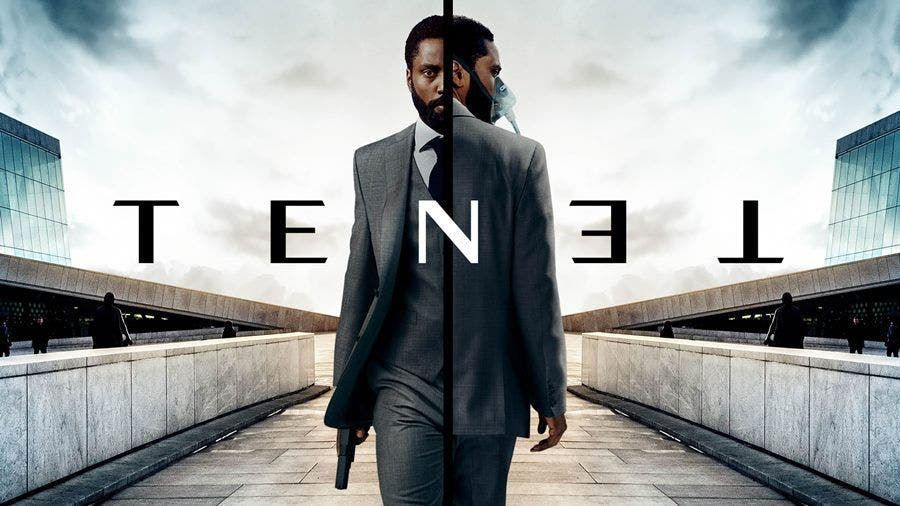
Following on from the masterpieces that are Inception, Interstellar, and Dunkirk, I was expecting further mind-bending perfection from Christopher Nolan with Tenet. Instead, I was disappointed. For the first time in my life I even considered walking out of the cinema.
Technically, there is nothing wrong with the film. The visuals are amazing (especially given the lack of CGI), the action sequences and fight choreography are impressive, and Ludwig Göransson delivers a perfect score- but otherwise it's a bit of a car (or plane, in this instance) crash. Scenes take place at breakneck speed, useful exposition is rare, and dialogue that's supposed to tell you what's going on from moment to moment is often deliberately too quiet to hear, either because of the deafening background sound effects or because the characters' mouths are obscured by masks. In a film that already makes you do some substantial mental gymnastics, you want to at least have some grasp of the plot, but I found even at the hour mark I still had no idea what was going on because I'd missed so many of the exchanges between characters. At one point towards the middle I thought I finally had a handle on things, but by the final action sequence I was just as confused as I was at the beginning. Needless to say, such a poor viewing experience has not made me enthusiastic about Tenet.
In an opening scene that perfectly sets up the general chaos of the rest of the film, ten minutes of Tenet's long runtime are wasted on introducing a main character who isn't even given a name. Although he is a spy and therefore meant to be slightly mysterious, we never know enough about him or his motivations to care whether he succeeds or not. The Protagonist is frequently stoic and rarely surprised by what he encounters, despite the high concept problems that are thrown at him, and we only know that he has emotional capacity towards the end of the film- once it's first been proved that he possesses the entire portfolio of traits expected of a leading character in this genre. John David Washington is a brilliant actor (if you haven't watched BlacKkKlansman yet I would strongly advise you to do so), but his potential is barely harnessed in Tenet. Likewise, Clémence Poésy is far from her glory days in Harry Potter and the Goblet of Fire, and delivers a listless explanation of time inversion during her brief appearance as scientist Laura. Robert Pattinson's character Neil is far more lively, but only his dashing scarf collection and bumbling British charm really add anything to the ensemble. The partnership between the Protagonist and Neil does, however, result in some comedic moments that lighten up the film's heavy tone, and their friendship is far more convincing than the relationship between the Protagonist and Kat is supposed to be.
The major failing of their relationship is Nolan's inability to create three dimensional and well-rounded female characters. Elizabeth Debicki has once again found herself playing the rich man's victim, as though doing that once in The Night Manager wasn't enough. Kat is a woman with very little autonomy, power, or significance in the grand scheme of the film. She is a means to an end and defined by motherhood and nothing else. For the majority of her screen time, she is forced from situation to situation without ever making any decisions for herself, and her one moment of independent victory is preceded by a potentially disastrous mistake that endangers the entire mission. Her male counterparts, meanwhile, are trusted to perform and succeed in every circumstance, frequently placed in positions of responsibility without their decision-making ability ever coming into question. Ultimately, the only thing the writers of Tenet entrust Kat and her tragic narrative with is powering the emotional engine of the film- but when this fails, all that's left is yet another portrayal of violence against women in mainstream cinema.
The prioritisation of concept over character development remains omnipresent throughout Tenet. Some characters are there simply as a way of quickly bouncing the Protagonist around from plot point to plot point, making it even harder for us to keep track of things, or as vehicles for introducing the world to the audience. The villain is Russian (quelle surprise!), an arms dealer (what a completely non-stereotypical vocation), and not very nice to people (nobody saw that one coming). He also abuses his wife, is heinously rich, and has a super yacht. Not Nolan's most original antagonist, and certainly not Kenneth Brannagh's best accent. Michael Caine has an easier time of things, but his five minute appearance as the head of British Intelligence is still entirely pointless, and seems to serve as an awkward way of continuing his streak of cameos in Nolan's films.
Given that this was the first time I'd been to the cinema in almost six months, and given Nolan's track record, I really wanted to like this film. But with Tenet he's made something that's confusing and inaccessible, and it feels deliberately exclusionary as a result. If you have to make the audience jump through that many hoops to have even a semblance of an understanding about what's happening onscreen, then you're doing it wrong. If Nolan were a less revered director, then he might be in danger of distancing his fan base; fortunately for him, he's in a position that means he's able to produce a slightly smug but sub-par film like Tenet without worrying he won't get the budget for the next one. It's perhaps this sense of security that made him pursue such an ambitious project in the first place- it's just a shame that such an interesting idea was so poorly executed. Tenet is certainly open to a sequel, so perhaps Nolan will do better a second time around, and hopefully with a better sound mixer.
Comments